
Taipei, Taiwan
CNN
–
Taiwan President Tsai Ing-wen said Monday that there is “no room for compromise” over the sovereignty of the autonomous island, but she is ready to work with China to find “mutually acceptable ways” to maintain peace across the Taiwan Strait.
“The Taiwan people’s consensus…is to defend our sovereignty and our free and democratic way of life. There is no room for compromise on this,” Tsai said in a speech marking the National Day of Taiwan, which he delivered at a time when tensions between Taipei and Beijing are at their highest level in recent decades.
Taiwan, with a population of 23 million, lies less than 110 miles (177 kilometers) off the coast of China. For more than 70 years, the two sides have been ruling separately, but that hasn’t stopped China’s ruling Communist Party from claiming the island as its own – even though it has never controlled it.
Chinese President Xi Jinping has said “reunification” between China and Taiwan is inevitable and has refused to rule out the use of force – but in her speech on Monday, Tsai urged Chinese leaders not to go down that path.
“I call on the Beijing authorities that resorting to war should not be an option for cross-Strait relations,” Tsai said. “Only by respecting the Taiwan people’s insistence on sovereignty, freedom and democracy can we resume positive interactions across the Taiwan Strait.”
In the wake of US House Speaker Nancy Pelosi’s visit to Taiwan in early August, China has intensified its military pressure tactics on the island, sending fighter jets across the middle line of the Taiwan Strait, the water body separating Taiwan and China.
For decades, the median line served as an unofficial line of demarcation between the two, with military incursions across it scarce.
Last week, Taiwan’s defense minister warned that Chinese fighter jets or drones interfering with Taiwan’s territorial airspace – defined as 12 nautical miles (22.2 kilometers) from the island’s shores – would be considered a “first strike”, as Taipei seeks to- intensify its defenses in response to Beijing’s military pressure.
Tsai said in her speech on Monday that Taiwan is an “important symbol” of democracy in the world and its people are determined to defend the island.
The international community is very clear that defending Taiwan’s security equals defending regional stability and democratic values. “If democratic freedoms in Taiwan are destroyed, it will be a major setback for democracies around the world,” she said.
She reiterated that Taiwan is strengthening national defense awareness, as well as acquiring and increasing production of precision weapons to enhance asymmetric warfare capabilities – a term that refers to military strategies to counter more powerful armies.
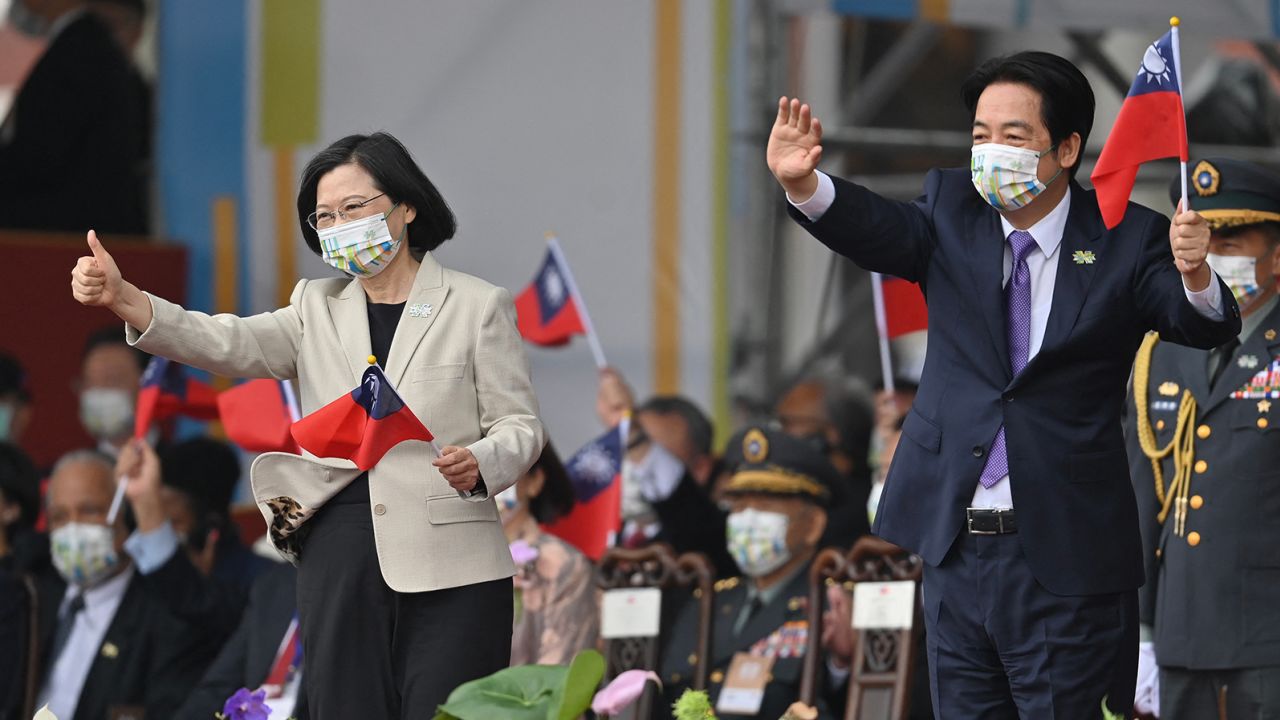
Taiwan’s capital, Taipei, on Monday celebrated the 111th anniversary of the start of the revolution in mainland China that eventually led to the collapse of its 2,200-year-old imperial system and the creation of the Republic of China.
The Republic of China ruled the mainland until its defeat by the Communists at the end of the civil war in 1949, when it retreated to Taiwan.
Monday’s celebrations were attended by international guests including the president of Palau – one of 14 countries that have full diplomatic relations with Taiwan. Also in attendance was US Congressman Eddie Bernice Johnson, a Democrat from Texas.
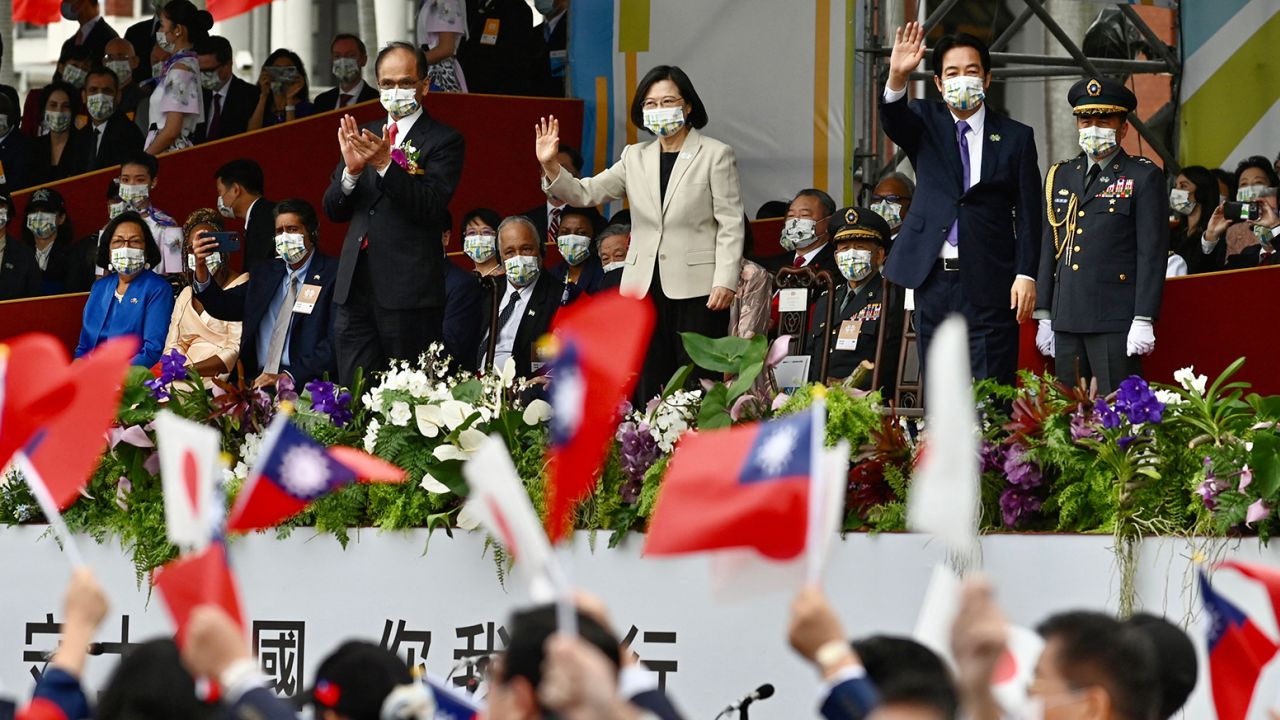
During the festivities, a military helicopter was seen flying over the cloudy skies of Taipei with a national flag, while military bands played outside the presidential office.
Analysts said Taiwan is likely to face mounting pressure from Beijing after Chinese leader Xi is widely expected to extend his grip on power for another five years at a Communist Party meeting scheduled to begin on Oct. 16.
“The biggest challenges will definitely be pressure from the PRC,” said Austin Wang, an assistant professor at the University of Nevada at Las Vegas who specializes in Taiwanese politics, referring to the PRC.
He predicted that Beijing’s policies toward Taiwan would become “more stable and unpredictable” in the medium term.
“If Xi is able to find a way to make his Covid-free policy and basic economic performance coexist together, this achievement will be big enough to make Xi and China patient,” Wang said, referring to China’s hard-line policy to contain the coronavirus. If China’s economy collapses, Xi and the People’s Republic of China will lose their legitimacy; Xi will then turn to nationalism, which includes the unification of Taiwan.”
Taiwan’s Defense Ministry said it is reviewing whether the mandatory military training of eligible men – set at four months – to be extended for a longer period in response to Beijing’s threat.
Lev Nachman, assistant professor of politics at National Chengqi University in Taiwan, said the Taiwan government should continue to engage the public about their role in defending the island.
“The best Taiwan can do is build its defenses at home in a way that is not flashy or provocative, but creates meaningful change that better prepares both Taiwan’s military and civil society for potential conflict,” he said.
Originally published at San Jose News Bulletin


No comments:
Post a Comment